
The Septenary Year
A proposed revision of the "Year of Fayen" time-keeping model of the Sinister Tradition.

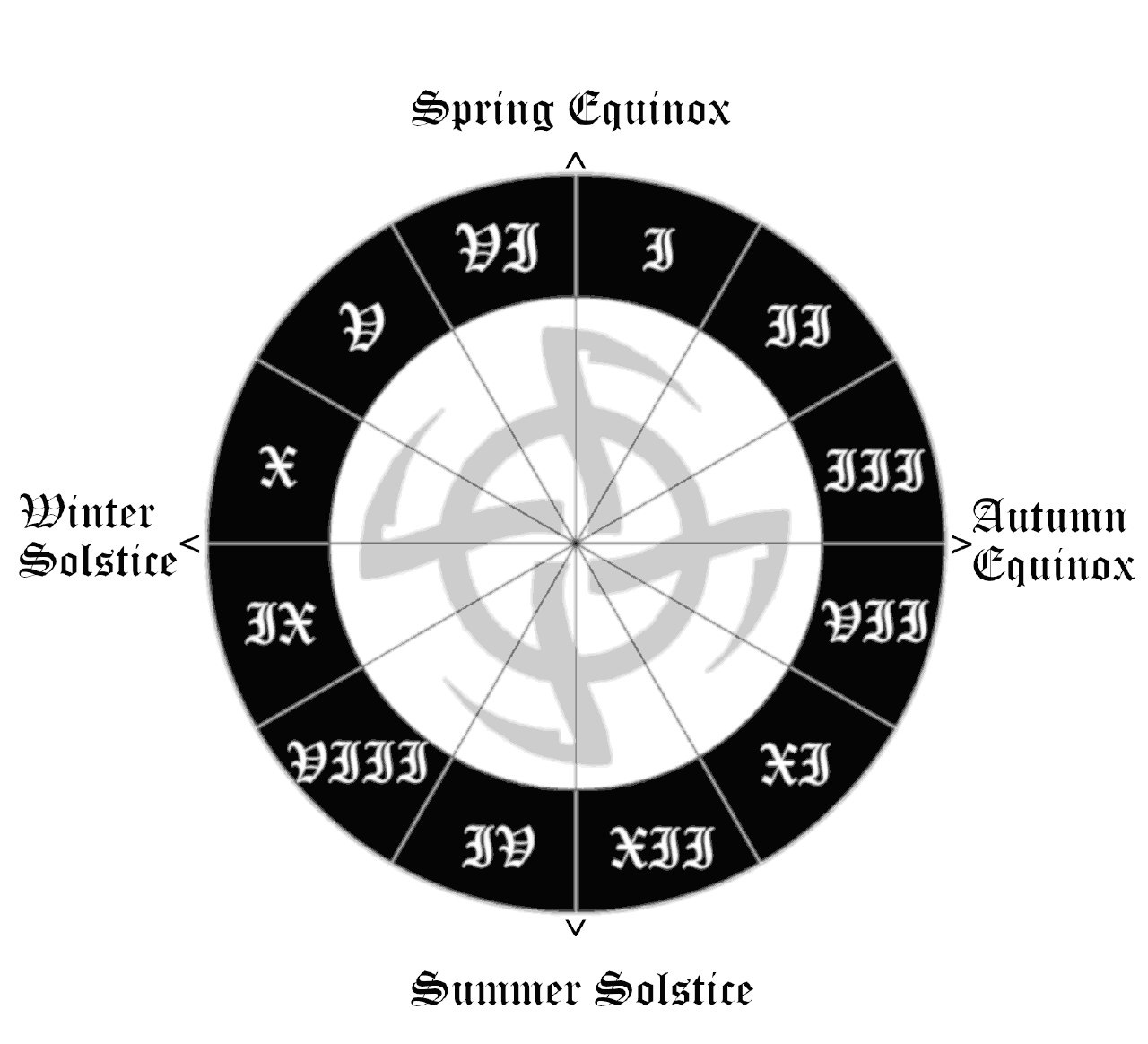
A proposed Year of Fayen revision (or perhaps return to Tradition), courtesy of Nomen Nescio, an associate of this Nexion.
---
Without question, the Sinister Tradition marks 1889 EV as its “year zero”, having since then counted every year since with the prefix of YF (the time of writing being YF 136 or EV 2025) or “Year of Fayen”.
However, the exact day in 1889 EV which marks YF remains uncertain.
The option many jump to, albeit impulsively and with no shortage of mistaken assumption, is April 20th for its obvious significance. While certainly a date to observe, and the National Socialists within our Tradition certainly do observe it, the complexity of the Sinister Tradition far exceeds just being National Socialist occultism. In addition, this date falls right on zero degrees of Taurus, and does not align with significant celestial phenomena otherwise.
April 20th is best observed, in my opinion, as a day of inspiration and of remembering what one should aspire to, where 18 is held up, not necessarily as an object of worship, but as an example of Wyrdful living and mastery of the Odinic art. One's personal thoughts towards National Socialism are quite irrelevant, as anyone can learn a thing or two from 18 if they possess the will and the maturity.
Another potential date aligns with the rising of Arcturus, as per “aural tradition” which varies based on latitude – and thus my own grievance with such a model. In England and other places along nearby latitudes, such a date would be approximately early to mid-April, and in my own region, it would be closer to late March. Certainly, the rising of particular stars is an excellent way to track entire years at a glance and with the artful simplicity of the Rounwytha, however, a system like this cannot serve the needs of day-to-day record-keeping. This system can, however, be used to test the accuracy of a certain model (which will be presented later on) by way of first learning the positions of the stars and their risings relative to one's latitude, and then comparing it to the calculated dates as a sort of “secondary anchor”. For example, in my own region, I should know if I've got Spring Equinox right if Arcturus rises roughly five to ten days later.
It would be up to each individual/temple to learn the relevant stars and mind their trajectories as needed, observing them in a way appropriate to the corresponding spheres. Such a thing would not be “universally” observed due to its very nature as being dependent on one's exact location. It does encourage a more “local” culture than that of online spaces so I heartily encourage such a practice as creating a kind of starry “signature” for various manifestations of the Tradition. I cannot state often enough the importance of each Nexion developing its own organic mutations of the root Tradition!
A more recent discussion with an esteemed peer who will remain anonymous yielded the suggestion of December 21st as a potential candidate for the start of the Sinister Year. While the Winter Solstice is something to be observed, as well as the transition into Saturn's sign of Capricorn – Saturn being at the apex of the Tree of Wyrd and a recurring symbol throughout the Sinister Tradition – the seasonal timing of December 21st makes it less about new life per se but more about the intimations of life's return on the horizon. This is a step in the right direction but not quite ideal.
December 21st could thought of as beginning the season of grim endurance and tenacity that Capricorn represents, having glimpsed the proverbial light on the far horizon and redoubling efforts to push forward. On this date we celebrate discipline and seek to kill weakness in ourselves, possibly via symbolic ritual sacrifices, rites of endurance in the form of flagellation or other painful exercises, fasting, or other acts which honor the Saturnian, iron-willed character of Capricorn.
I propose the following:
The Equinoxes and the Solstices are four consistent “anchors” for timekeeping, and it is these anchors that the proposed model is built upon. Each Equinox or Solstice is in itself a “Liminal Day” which is not counted – a null-day of seasonal transition. Each seasonal quarter is split into thirds, which are the closest whole number divisions of the 365.24 solar days which make up a year. Each third will be referred to by a corresponding alchemical name of Salt, Mercury, or Sulfur depending on their place in the seasonal progression. I assume the reader understands which order these are meant to go in and if not – correct that!
A full date would then be “17th Salt of Spring, YF136”.
After the final day of Winter Quarter, there is an additional Liminal Day before the Spring Equinox itself, meaning that the Gregorian dates of March 19th and March 20th are both nulldays before the helix-cycle starts again on March 21st. Every four years, a third Liminal Day is added to this period, meaning that March 18th, 19th, and 20th are all null-days for that year. YF136 is one such year, and the next will be YF140. This “Leap-Liminal” rule does not apply every 100 years unless divisible by 400 (to account for the leftover time which will accrue by dividing a solar year up equally), and so YF400 will be something of a milestone. Generational upkeep will be required, ideally via an assigned temple role or some kind of sanctioned online outlet.
At present, there are many useful online resources for determining the dates of Equinox and Solstice, and figuring this out for oneself isn't terribly difficult once the dates are understood. what is Spring Equinox in the Northern hemisphere is Autumn Equinox in the Southern hemisphere. The March Equinox takes place somewhere between March 19th to March 21st on the Gregorian calendar, while the September Equinox occurs between that month's 21st and 24th. Nighttime and daytime hours will be more or less equal on the Equinox.
Solstice occurs when the Sun is directly over either the Tropic of Cancer or the Tropic of Capricorn (Northern and Southern hemisphere respectively). In the Northern hemisphere, June Solstice (between June 20th and 22nd) represents Summer Solstice and December Solstice (between December 20th and 23rd) represents Winter Solstice. However, for the Southern Hemisphere, this is flipped. The Summer Solstice is known for having the longest day and the shortest night, while the opposite is true of the Winter Solstice.
So as to provide an example for the reader and get the ball rolling on the Septenary Year, I have charted the following Gregorian dates and their corresponding Septenary dates for YF136/EV2025:
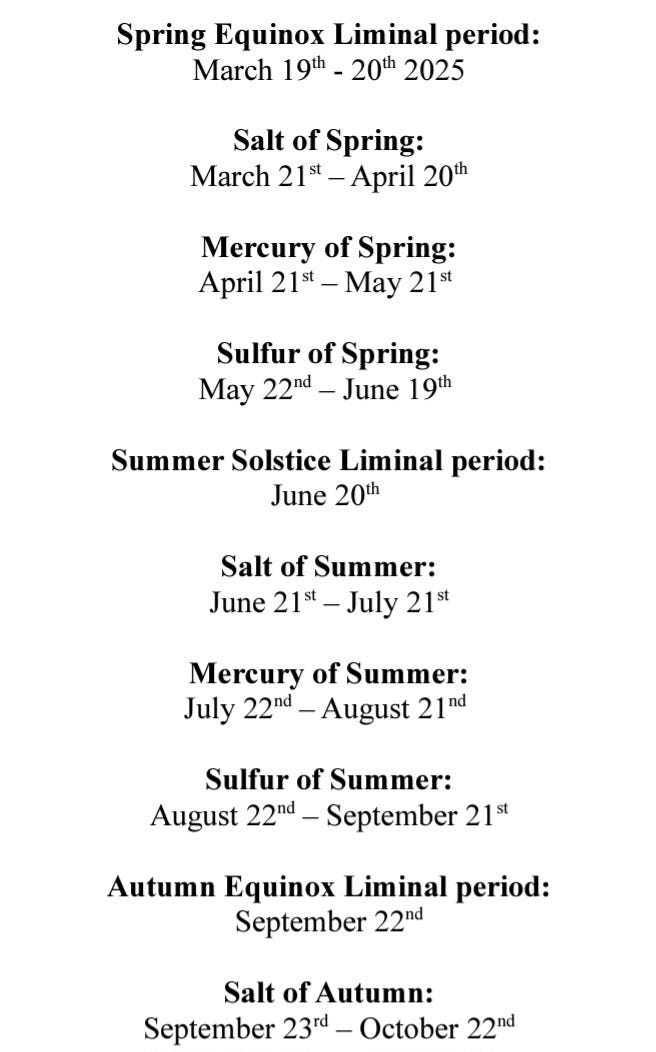
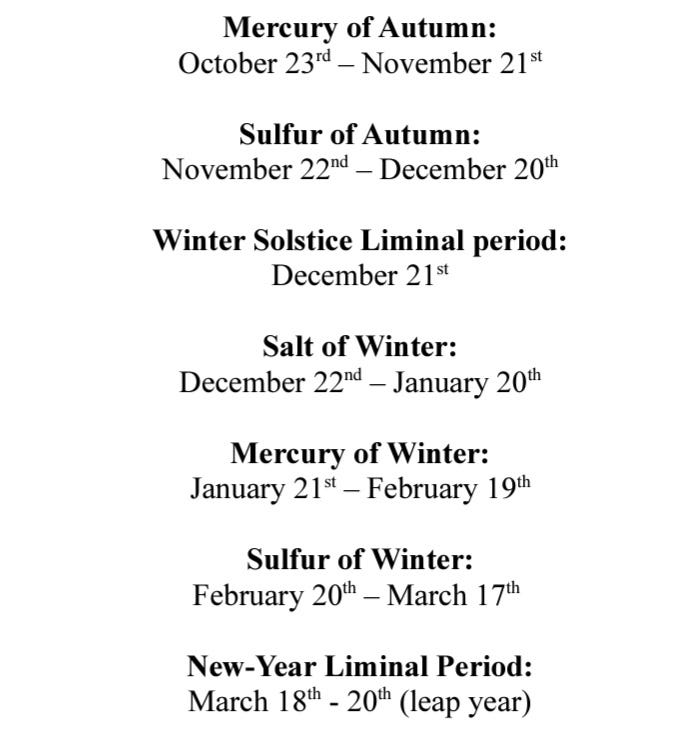
In calculating these, the shortest set of days always goes to the final third. I have found it is also best to work backwards from Each Equinox/Solstice. Once the crucial Liminal Days are determined IE The Equinoxes and Solstices, The rest is fairly simple to chart out and can be done with a few hours of diligent work.
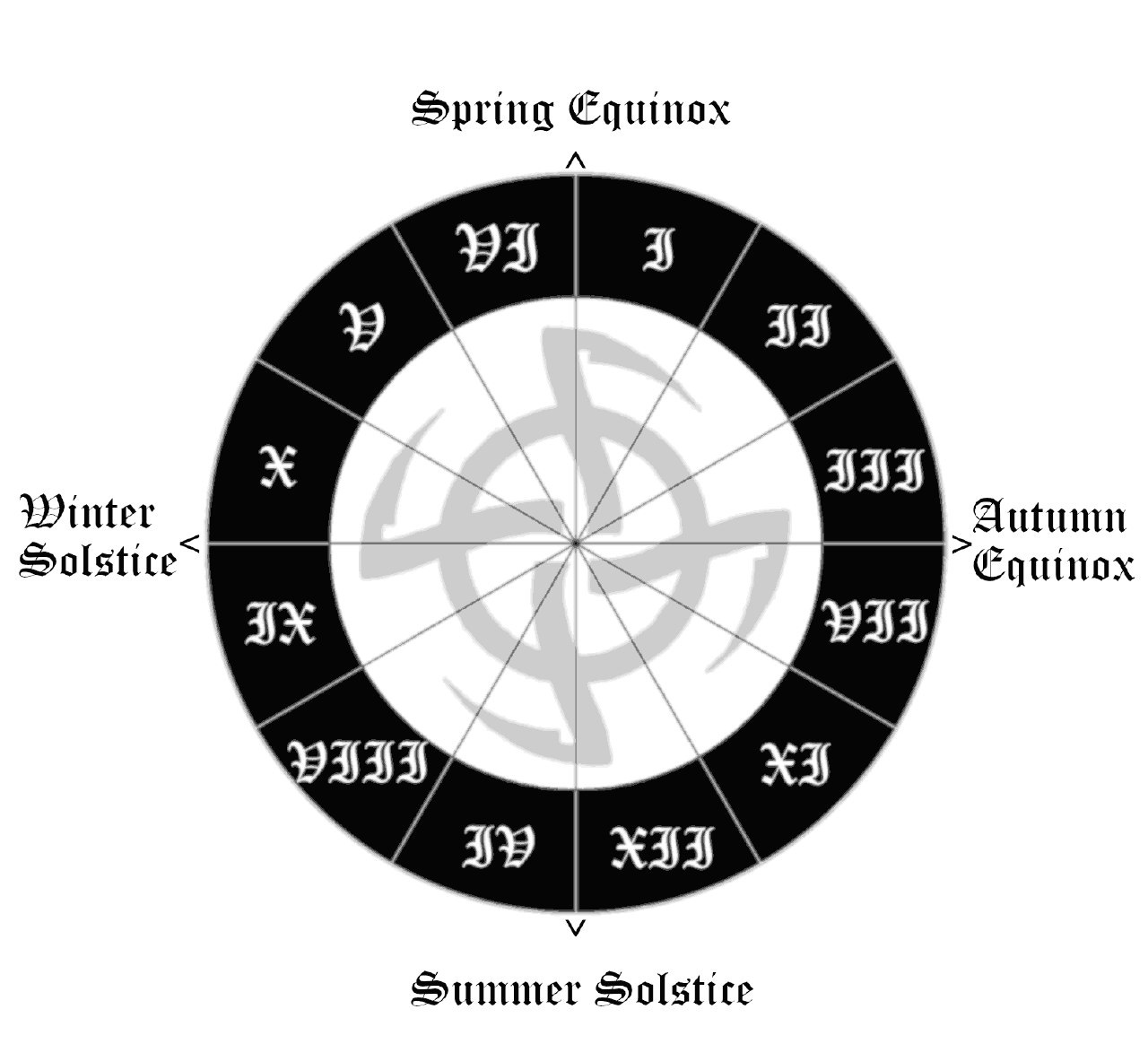
I have elected to utilize an old form from the early days of this fine Tradition, which appears as a cycle but actually traces a winding path so as to convey the true helical nature of time as a series of orbits within orbits.
- Nomen Nescio 12th Salt of Spring, YF136 (EV April 1st, 2025)
NOTE – the proposed model assumes a starting date of EV March 21st, 1889 as our “year zero”, retaining 1889 as its Gregorian anchor year due to its various significant events E.G. the birth of 18, the descent of Friedrich Nietzsche into madness (referring to himself in terms of varying divinity). Other key events such as the debut of AC power and the formation of the Second International would shape the following century and beyond, these pivotal moments marking 1889 as the crossing of a Wyrdful Threshold.
Fuck me.i'll have to read it few times to fully understand....bur undoubtedly one of the most "practical" mms which comes from you lot.
That is an odd order.
When it comes to solar years, I use the prechristian European one with a new year a week into November, but regard the Yule starting ones too.
That 1, 2,3, 7, 11, 12, 4, 8, 9, 10, 5, 6, bit for the months is a touch confusing.